1915 Serbian War Calendar
A Serbian War Calendar, mainly in Cyrillic text, for the year 1915, published in New York, USA. The cover has the Cyrillic text 'РАТНИ КАЛЕНДАР за 1915 ГОД.', which transliterates to 'Ratni Kalendar za 1915 god.', and which translates to 'War Calendar for 1915 year'.
CREATOR
Špiro Vranješ
DATE
1915
LANGUAGE
srp
ITEMS
8
INSTITUTION
Europeana 1914-1918
PROGRESS
METADATA
Discover Similar Stories
1918 Serbian War Calendar
16 Items
A Serbian Calendar for the year 1918. The cover has the text, in Serbian Cyrillic 'Календар ДОМОВИНА за ПРОСТУ 1918 ГОДИНУ', which transliterates to 'Kalendar DOMOVINA za PROSTU 1918 GODINU', and which translates as 'Homeland Calendar for the Year 1918'. The edition is by the Serbian Ministry for Education and Church Affairs, which was based in Corfu since the Serbian Retreat of winter 1915. Original price, given on the back cover, was 1 Greek Drachma or 1 French Franc.

French medal for Serbian prisoners-of-war
6 Items
This is a French medal to commemorate Serbian prisoners-of-war. One one side is an image of, on the left, King Peter, and his son, the Prince Regent Alexander. French versions of their names appear, respectively, as 'Pierre I' and 'Alexandre'. Beneath this is the bilingual, French-Serbian text 'GLORIEUX DEFENSEURS DE LA LIBERTE SERBE' and, in Cyrillic 'СЛАВНИ ЗАТОЦНИЦИ СРПСКЕ СЛОБОДЕ' (translating as 'Honour to the Defenders of Serbian Freedom'), followed by the years 1914-1915. The other side of the medal features the Serbian heraldic shield with the years 1389, the year of the Battle of Kosovo, and 1817, the conclusion of the Second Serbian Uprising, when Serbia became a principality. The year of issue, 1917, is shown at the top, and was the centenary of the Second Serbian Uprising, and there is also French text 'OEUVRE DES PRISONNIERS SERBES' (translating as 'The Work of Serbian Prisoners'). The ribbon has the same colour scheme as the French tricolour: blue, white, and red. || French medal for Serbian prisoners-of-war.
Serbian prisoner-of-war Red Cross postcards
6 Items
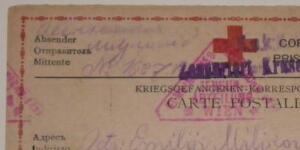
Here are several postcards sent by Serbian prisoner-of-war, Aleksandar Miljkovic, in Branau, Austria, which is near the German border, to his mother Emilija Miljkovic, in Krusevac, Serbia. The postcards are dated from 1917 and 1918. The contents, written in faded pencil, might seem mundane, with thanks for a parcel his mother had sent him, for the socks, Serbian 'pogaca' bread, some cake in a box, and so on, but such letters were an important lifeline in communication between incarcerated soldiers and their relations back home, as well as evidence of the good work that the Red Cross was doing in facilitating this. || Three Red Cross postcards send by a Serbian prisoner-of-war in Braunau, Austria, to his mother in Krusevac, Serbia.