Amalgamated Society of Carpenters and Joiners clearance
Clearance to move from one branch to another
CREATOR
Elaine Callinan
DATE
1920-01-13
LANGUAGE
eng
ITEMS
1
INSTITUTION
Europeana 1914-1918
PROGRESS
METADATA
Discover Similar Stories

Medal of the Red Cross Society of the Kingdom of Serbia
8 Items
The Medal of the Red Cross Society of the Kingdom of Serbia was established in 1912 and was awarded to those who had aided the sick and wounded, and was given to deserving men and women, whether Serbian and non-Serbian. The first version of this medal was awarded during the First and Second Balkan Wars of 1912 and 1913 respectively. The version shown here were specifically awarded during the First World War, and which had its own version of the design. On one side is an enamelled red cross with the text in Serbian Cyrillic, 'ЗА УСЛУГЕ СРПСКОМ ЦРВЕНОМ КРСТУ', which transliterates as 'Za Usluge Srpskom Crvenom Krstu', and which translates to 'For Service to the Serbian Red Cross'. There is also a small Serbian heraldic eagle at the bottom and an oak leaf branch surrounding more than three-quarters of the edge of the design. The First and Second Balkans Wars version of this medal also had the years '1912-13' just over the eagle, and the post-First World War version omits the word, 'СРПСКОМ' ('Serbian', in English), to reflect the wider scope of the Red Cross following the post-war creation of the Kingdom of the Serbs, Croats, and Slovenes. The other side of the medal has the design featuring the 'Kosovska Devojka' (Maiden of Kosovo) character from the Serbian epic poem of the same name, with the dying figure of the Serbian knight, Pavle Orlovic, being cared for by the young woman, as he tells her that her fiance and blood brothers have been killed. Beneath this is the year 1389, which was the year of the Battle of Kosovo. In 1919, Serbian Realist artist, Uros Predic produced an iconic oil painting of a scene similar to that on this medal. When the medal was awarded to women, it came with a bow-shaped ribbon, and when awarded to men, it came on a triangular ribbon. These medals come with white ribbons with red edging, which signifies that they were awarded during war time. When such medals were awarded with all-white ribbons, with no red edging, those were given during peace time. Also shown here is a miniature version of this award. || Medals of the Red Cross Society of the Kingdom of Serbia, both male and female-awarded versions, plus a miniature version.

Cross of the Red Cross Society of the Kingdom of Serbia
17 Items
The Red Cross of Serbia was formed in 1876 and was the recognised by the International Committee of the Red Cross in the same year. The first Serbian Red Cross decoration was established in 1877, when Serbia was a Principality. After 1882, when Serbia became a Kingdom, the design of the cross was replaced with the type shown here, which was awarded throughout the First World War. The Cross was awarded to men and women, Serbian or foreign, for taking an active role in the nursing of the wounded in wartime. During peacetime, the ribbon was white, but when awarded during wartime, the ribbon was mainly white with red stripes near the edges. When the war broke out in 1914, Serbia and Austria, who produced many medal and order types for Serbia, broke relations, and Serbia then sourced production and supply of these Crosses from the firms of Arthus Bertrand, of France, and Huguenin Freres, of Switzerland. Also shown are the presentation case for the award and a couple of examples of miniatures for the same award. The award certificate shown here, as titled, comes in the name of King Peter I, and was awarded to French citizen, Marcelle Antoine Vignier, of the Paris suburb of Sannois. The certificate is dated May 1921, and it was not uncommon for people to be awarded certificates some years after the end of the war. A minor anomaly is that, at the top left of the certificate, it shows the design of the old-style Cross, which was only in use from 1877 through 1882, after which the new design, as shown here and used throughout the First Worlds War, was adopted. || A Cross of the Red Cross Society of the Kingdom of Serbia, where the red enameled cross has a heraldic, Serbian eagle on the front and '1876', the year of the foundation of the Serbian Rec Cross Society, on the reverse, with a crown above the cross. A presentation case for the Cross of the Red Cross Society of the Kingdom of Serbia award. Two miniatures of the Cross of the Red Cross Society of the Kingdom of Serbia. An award certificate for the Cross of the Red Cross Society of the Kingdom of Serbia given to a French citizen.
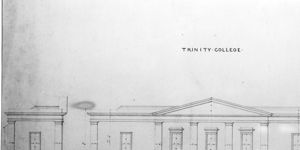
Plan of the stables of the Provost of Trinity College and of improvements of Nassau Street and Clare Street
1 Item
The widening of Nassau St. by the Wide Streets Commission in 1841 necessitated the purchase of part of the grounds pertaining to the Provost’s House, Trinity College, Dublin. A condition of sale was that the Provost’s stables and other outbuildings, which had to be demolished, should be rebuilt at the Commission’s expense. This series of five drawings, which details the re-building of the stables and other outbuildings and the erection of new gates and railings, was submitted to the Commission by Frederick Darley in July 1841. The drawings were approved but with minor modifications of a decorative nature which reduced costs by £315. The final costs amounted to £6,215-15s-6d. Scale: 10' 1''