Harry Boater from Canning Town
The interview was conducted by Age Exchange in partnership with The University of Essex and The First World War Centre –University of Hertfordshire –as part of the Children of The Great War project.
Harry Boater came from a family of seven in Canning Town, East London.
On Nov 23 1914 he enlisted with the Royal Field Artillery and served in France from July 17 1915 to Oct 25 1917, and again from July 8 1918 to Feb 9 1919.
During the Second Battle of the Somme in August 1918, Harry was Gassed with Mustard Gas, which later led to him receiving a Pension. On another occasion, while in charge of a gun, the gun jumped on firing and he was caught by it, receiving facial injuries from the hand spike. He was discharged on March 10 1919.
Harry was photographed on horseback at Merville, this was copied by ‘a French lady’ for a painting which is now in the family.
In the interview his daughters talk about the character of their father, and his enthusiasm for life.
A joint project between Age Exchange, the University of Essex and the Everyday Lives in War FWW Engagement Centre, University of Herts. For further information, please contact Everyday Lives in War, https://everydaylivesinwar.herts.ac.uk/
Harry Boater on horseback
Henry Harry Boater
Photograph
Harry Boater in uniform
Other
tags belonging to Harry Boater
CREATOR
Maureen Watson and Audrey Field
DATE
1914-11-23
LANGUAGE
eng
ITEMS
3
INSTITUTION
Europeana 1914-1918
PROGRESS
METADATA
Discover Similar Stories
Charles Frederick Canning
6 Items
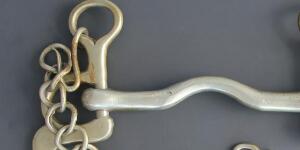
Charles Frederick Canning was the great uncle of the contributor, Paul Canning. He served in the Queen's Own Oxfordshire Hussars in the Yeomanry Regiment, Woodstock Squadron. His regiment number was 285680. He was transferred to a military hospital in Pas de Calais but died of his wounds aged 20 on 11 December 1917. His horse was named Boy, as seen on the base of his stirrups. The horse's bit, stirrups and spur were brought back by a friend in the same regiment and given to his parents. || Horse's bit, Horse's stirrups, Horse's spur.

Monaghan Town housing scheme named after refugees from Mechelen (or Malines) | Belgium
1 Item
In the autumn of 1914, the first urban housing scheme in Monaghan town (a converted military barracks and new 'working class' or 'artisan' houses) was nearing completion when local councils around the British Isles were called on to accommodate a stream of refugees crossing the English Channel from Belgium. Monaghan Urban District Council agreed to take some of the refugees and house them in the new development. Fifteen refugees, mostly women and one child, arrived by train in Monaghan town on Friday 30 October 1914 and were met at the station by a handful of local dignitaries. Four cars, which must have been a rare site in the town at the time, took them to the new artisan dwellings. The child, a tot of three or four, 'seemed full of joy at the prospect of a motor car drive'. A meeting had been held in the courthouse the previous Wednesday to prepare for the arrival of the Belgians. A small committee of local ladies was formed - Mrs Leonie Leslie, Mrs Sarah Campbell Hall, Mrs Keenan, Mrs Kieran and Miss Richardson. Mrs Leslie's son, Norman, had been killed in the war, at Armentières, during the previous fortnight. The committee bought furniture and organised bed-linen and other items for the houses where the refugees were to live. Money and donations were raised from local people to help sustain the refugees. The minute book of Monaghan Urban Council tell us that at a council meeting of 5 January 1915, the motion of William Breakey 'that the former military barracks grounds be henceforth known as Belgium Square and the Terrace in which the Belgians reside hereafter called Maline Terrace' was seconded by James McCaldin and declared passed. It is therefore likely that the refugees came from the Mechelen (Malines) area just south of Antwerp. Antwerp was attacked by the Germans in August 1914 but the Belgians drove them back. According to the controversial Bryce Report of 12 May 1915, the Germans, irked by the defeat, carried out many atrocities against the Belgians, who were terrified and took to the roads to escape the German army. 250,000 Belgians crossed the English Channel in the following 18 months and their names are preserved in the Register of Belgian Refugees, held by the UK National Archives at Kew, London. The register is indexed by surname, with no index arranged by location, making it very difficult to find the names of those who came to Monaghan. A local newspaper, the Northern Standard, reported that Professor Wollard (retired) and his wife were amongst those who came to Monaghan. Wollard's father had owned a large business in Ghent. He had been acting as a translator in the refugee holding centre at Alexandra Palace before he came to Monaghan. His house had been burned by the Germans, who threw lighted sticks covered with tar and naptha into it to set it alight. The professor held French classes in the YWCA hall on the North Road while he was here. Another man who came to Monaghan was Mr Loots, who had to flee from his home when it was bombarded. On 31 March 1915 the council recommended that the name Belgium Square be carved on an inscription stone which can still be seen there today - image attached. The name 'Maline Terrace' does not survive as a place-name in the town, however, inhabitants of the area can still point it out. This is not the end of the story. While they were in Monaghan, the Belgian ladies began to make lace and embroider items to earn some money. Rose Gallagher and her husband Charles McNally employed some of the Belgians and set up a machine lace factory called the Belbroid in Monaghan town. The company went on to employ over 150 people and had a premises on Mill Street, up an entry directly opposite the Post Office. A Belbroid camisole can be seen on the internet at open.jorum.ac.uk/xmlui/handle/123456789/10970. The Belbroid opened shops in Dublin and also took mail orders. An Irish Times report of 24 September 1924 claims that it was one of the most prosperous industries in Monaghan. There are many Belbroid advertisements in the Irish Times in the early 1920s and and advertisement with a mail order coupon, appeared in The Glasgow Herald, 17 December 1921. A local woman whose mother worked in the Belbroid related that the Belgians left Monaghan when the war was over but came back periodically to advise the Belbroid owners on new developments in machine-lace production. Belgian refugees in Clones and Castleblayney are also mentioned in Northern Standard reports. If anyone in Mechelen could help identify descendants of the refugees who came to Monaghan town or if they know of any Belgian refugees who spent time in the county, please contact Clogher Historical Society/Cumann Seanchais Chlochair through the website www.clogherhistory.ie. The 100th anniversary of their arrival approaches and it would be lovely to mark the occasion by inviting descendants back to Monaghan. || photo || || Photograph || Manufacture || 54.2547541,-6.966110500000013 || Women || Date stone, Belgium Square 1914
