The Poet of Ruhleben
This is the story of my great uncle, Cecil Duncan-Jones. He was born in 1883 and was originally from London. Unlike his elder brother, he did not attend university but pursued a life as an actor, poet and novelist. He was tall, dark and handsome and although he struggled a little for money, he loved acting and had played the Duke of Orleans in Henry V.
In 1914 he was in Alsace Lorraine recovering from an operation when the war broke out. He was among many British nationals caught out by the start of the war and was taken, along with 600 others, to a camp at Ruhleben near Berlin. During his captivity, he continued to adapt and put on plays, he also wrote a volume of poetry entitled 'In Captivity'.
By the spring of 1918, he was still in the internment camp but his health was deteriorating due to malnourishment. He was therefore discharged and allowed to travel to Holland (near the Hague), hoping to get to England on an ambulance convoy.
A letter to his aunt Millie (on his mother's side) written on 15th October 1918 described living in hotels as it was more economical and his dramatic interests keeping his spirits up. By this time, his health had deteriorated further and his gums were bleeding. He managed to leave Holland on the last ambulance ship but he was very ill and he died, soon after his return, on 10th November 1918.
A portrait of Cecil Duncan-Jones in charcoal, drawn by a friend;
a typescript copy of his book of poems written in captivity;
copies of his letters.
Scheveningen near the Hague
Front
A letter written by my great uncle, Cecil Duncan-Jones to his aunt Millie from Holland as he waited to leave for Britain on an ambulance ship
A letter from my great uncle
Cecil Duncan-Jones
Letter
Drawing
A portrait of my great uncle, Cecil Duncan-Jones
Ruhleben
Excerpt from typescript of my great uncle's poems, written in captivity.
Poem
Poems by my great uncle, Cecil Duncan-Jones
CREATOR
Katherine Duncan-Jones
DATE
1914-08 - 1918-11-10
LANGUAGE
eng
ITEMS
9
INSTITUTION
Europeana 1914-1918
PROGRESS
METADATA
Discover Similar Stories
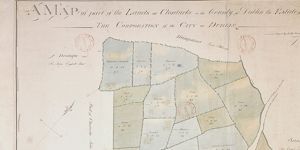
A Map of part of the Lands of Clonturke in the County of Dublin estate of the Corporation of the City of Dublin.
1 Item
Plan of 29 fields numbered consecutively 53-81, giving acreage and cultivation of each. Shading also indicates varying types of cultivation. Dublin-Swords-Drogheda road runs through fields which are adj. To Sir Compton Domville's estate.

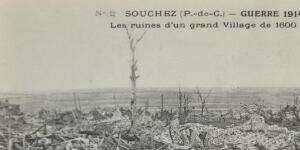
Postcard - The ruins of the village of Souchez
1 Item
Postcard - No. 2 Souchez (Pas-de-Calais). War 1914 - 1916. The ruins of a large village of 1600 people. Caption: No. 2 Souchez (P-de-C). Guerre 1914-1916. Les ruines d'un grand village de 1600 habitants. || Front