Someone else is currently editing this document
Only one person can work on a document at a time
Diary 3: May 1936 - February 1937 Item 55
TRANSCRIPTION
Danzig, 16th October 1936.
When I went to Geneva first in September for a
day to see Avenol he mentioned to me incidentally that
he hoped shortly to be in a position to make an interesting
proposal. He could not say more at the moment.
Two days after my return to Danzig I saw an
announcement that Azcarate had resigned from the post
of Deputy-Secretary-General on being appointed Spanish
Ambassador in London. There were also one or two
directorships vacant in the Secretariat, and going down
to Geneva again for the Council and Assembly I did not
of course mention the matter in any way and proceeded
with my discussions with the Rapporteur's delegation.
I saw Avenol and had a general talk with him on the
situation in Danzig and the prospects but it was not
until some days later as we were walking together
towards the new Council room for a discussion on the
"Leipzig" incident that he again spoke of it. He drew
me aside in the corridor and asked me what I would say
about theproposal to be the new Deputy-Secretary-General
I said that I would feel very flattered at such a
proposal but that I would like to think the matter
over. I had never had any thoughts of joining the
Secretariat. At the same time I did express my appreciation
of what was a very big compliment. He said
he was sure the appointment would be a most popular
one generally in the League of Nations but that there
might be one or two difficult points he would have to
surmount.
During the next week I heard rumours of many
efforts being set on foot to secure the appointment
for various nationals; every Government which thought
it had some hope was of course exceedingly anxious
to secure the appointment. There were three or four
candidates in the Secretariat itself: Rajchman, Pelt,
(the Dutch Director of the Information Section) Ekmann,
(The Swedish Director of the Social Section) and Aghnides
Greek Director of the Disarmament Section who had
been later doing personnel work. The Polish Government
were not apparently backing Rajchmann but were strongly
pressing for another candidate and claiming succession
on the basis of being the next semi-permanent member
of the Council. (It was on this principle that I had
held up Azcarate's nomination for three months while
I was sitting on the Council.)
The secret was pretty well kept until the first
meeting of the Committee of Three dealing with Danzig.
I was not present but the situation had been examined
on the basis of my reports and a chance made to the
first general conclusion that the League could not
divide its guarantees in Danzig; if one could not be
maintained neither could any other. At this stage
Avenol interrupted and said he wished to talk with the
three Foreign Ministers alone, Eden, Delbos and
Monteiro. All the secretaries and advisors were
cleared out and it appears that Avenol at this point
said that as it might affect the Danzig situation he
wanted the Committee to know that he proposed to
nominate me as his Deputy.
That was, I think, 29th September. The following
morning Eden asked me to see him and he came out of
the Assembly discussion for the purpose. He said that
Avenol had told him of his proposition and he wanted
to know what I would think about it. Would I consider
that I was being let down in any way? I had already
heard, by the way, that the matter had been mentioned
privately to Cranborne before Eden's arrival and he
had apparently had nothing to say against the appointment.
I told Eden that I would not look upon the
nomination in that way a t all. It was a very high
Language(s) of Transcription
LOCATION
Gdańsk (Poland) (54.3612, 18.5499)
Story Location
ABOUT THIS DOCUMENT
Document Date

Document Type
Document Description
Language of Description
Keywords
External Web Resources
STORY INFORMATION
Title
Diary 3: May 1936 - February 1937
Creator
Lester | Seán | 1888-1959
Contributor
Lester, Seán, 1888-1959
Seán Lester
Coverage
name=Twentieth century; start=1936-05-06; end=1937-02-01
Date
6 May 1936-1 February 1937
Type
Text
Rights
This collection has been digitised and made available by Dublin City University Library. Please credit Dublin City University Library when using these images, creativecommons.org/licenses/by/4.0/
Language
eng
Identifier
#ng45f7525
LandingPage
https://www.europeana.eu/item/707/_ng45f7525Country
Ireland
DatasetName
707__Dublin_City_University
Begin
1936-05-01
End
1937-02-28
Language
en
Created
2022-03-23T16:13:34.244Z
2022-03-23T16:14:08.313666Z
2022-03-23T16:14:08.314189Z
Story Description
Consists of unbound typed diary entries, documents and letters relating to Lester's final months as High Commissioner of the League of Nations in Danzig. Lester left Danzig on 22 December 1936 having been promoted to the position of Deputy Secretary General of the League. He took up his new appointment in Geneva on 16 January 1937. Includes document written by Lester outlining the context for the file: 'The following fragments are the only notes I have of my last six months in Danzig ... The reason they are so fragmentary ... was that the crisis in Danzig developed so quickly and in such uncertainty that I could not safely keep any record of certain matters, either in my house or my Office. For three months at any rate I was not at all sure that my house and Office might not be occupied any day by the political Police or the Storm Troopers [sic].' - Document comprising of two diary entries, the first from 6 May 1936 (pages 1-3) and the second from early July 1936 (pages 4-9) combined together as a single entry. The section from 6 May 1936 is duplicated in Diary 2: January-June 1936 in the collection [diary C1/2]. Includes diary entries (some marked 'Private Diary') from the following dates: 8, 17, [?20], 23 (two entries with this date, one titled 'Relations with Greiser'), 24, and 28 July 1936; 3, 5, 6 and 7 August 1936 (two copies); 12 September 1936; 16, 19 and 24 October 1936; 22 December 1936 and 1 February 1937. Entries were all written in Danzig apart from the final entry (1 February 1937) which was written in Geneva. Includes undated notes on Albert Forster, the Nazi Party's Gauleiter in Danzig, that was originally filed between diary entries from 24 October 1936 and 22 December 1936, and was thus possibly written during that period. Includes copy letters from Lester to Joseph Avenol, Secretary General of the League of Nations, from the following dates: 11, 14 and 24 July 1926; 1 August 1936 (two copies of two different letters from this date). Most of the letters are marked 'Personal', 'Personal and Confidential', or 'Personal; Secret'.


TRANSCRIPTION
LOCATION
DESCRIPTION
PEOPLE
STORY INFO
TUTORIAL
Danzig, 16th October 1936.
When I went to Geneva first in September for a
day to see Avenol he mentioned to me incidentally that
he hoped shortly to be in a position to make an interesting
proposal. He could not say more at the moment.
Two days after my return to Danzig I saw an
announcement that Azcarate had resigned from the post
of Deputy-Secretary-General on being appointed Spanish
Ambassador in London. There were also one or two
directorships vacant in the Secretariat, and going down
to Geneva again for the Council and Assembly I did not
of course mention the matter in any way and proceeded
with my discussions with the Rapporteur's delegation.
I saw Avenol and had a general talk with him on the
situation in Danzig and the prospects but it was not
until some days later as we were walking together
towards the new Council room for a discussion on the
"Leipzig" incident that he again spoke of it. He drew
me aside in the corridor and asked me what I would say
about theproposal to be the new Deputy-Secretary-General
I said that I would feel very flattered at such a
proposal but that I would like to think the matter
over. I had never had any thoughts of joining the
Secretariat. At the same time I did express my appreciation
of what was a very big compliment. He said
he was sure the appointment would be a most popular
one generally in the League of Nations but that there
might be one or two difficult points he would have to
surmount.
During the next week I heard rumours of many
efforts being set on foot to secure the appointment
for various nationals; every Government which thought
it had some hope was of course exceedingly anxious
to secure the appointment. There were three or four
candidates in the Secretariat itself: Rajchman, Pelt,
(the Dutch Director of the Information Section) Ekmann,
(The Swedish Director of the Social Section) and Aghnides
Greek Director of the Disarmament Section who had
been later doing personnel work. The Polish Government
were not apparently backing Rajchmann but were strongly
pressing for another candidate and claiming succession
on the basis of being the next semi-permanent member
of the Council. (It was on this principle that I had
held up Azcarate's nomination for three months while
I was sitting on the Council.)
The secret was pretty well kept until the first
meeting of the Committee of Three dealing with Danzig.
I was not present but the situation had been examined
on the basis of my reports and a chance made to the
first general conclusion that the League could not
divide its guarantees in Danzig; if one could not be
maintained neither could any other. At this stage
Avenol interrupted and said he wished to talk with the
three Foreign Ministers alone, Eden, Delbos and
Monteiro. All the secretaries and advisors were
cleared out and it appears that Avenol at this point
said that as it might affect the Danzig situation he
wanted the Committee to know that he proposed to
nominate me as his Deputy.
That was, I think, 29th September. The following
morning Eden asked me to see him and he came out of
the Assembly discussion for the purpose. He said that
Avenol had told him of his proposition and he wanted
to know what I would think about it. Would I consider
that I was being let down in any way? I had already
heard, by the way, that the matter had been mentioned
privately to Cranborne before Eden's arrival and he
had apparently had nothing to say against the appointment.
I told Eden that I would not look upon the
nomination in that way a t all. It was a very high
- English (English)
Danzig, 16th October 1936.
When I went to Geneva first in September for a
day to see Avenol he mentioned to me incidentally that
he hoped shortly to be in a position to make an interesting
proposal. He could not say more at the moment.
Two days after my return to Danzig I saw an
announcement that Azcarate had resigned from the post
of Deputy-Secretary-General on being appointed Spanish
Ambassador in London. There were also one or two
directorships vacant in the Secretariat, and going down
to Geneva again for the Council and Assembly I did not
of course mention the matter in any way and proceeded
with my discussions with the Rapporteur's delegation.
I saw Avenol and had a general talk with him on the
situation in Danzig and the prospects but it was not
until some days later as we were walking together
towards the new Council room for a discussion on the
"Leipzig" incident that he again spoke of it. He drew
me aside in the corridor and asked me what I would say
about theproposal to be the new Deputy-Secretary-General
I said that I would feel very flattered at such a
proposal but that I would like to think the matter
over. I had never had any thoughts of joining the
Secretariat. At the same time I did express my appreciation
of what was a very big compliment. He said
he was sure the appointment would be a most popular
one generally in the League of Nations but that there
might be one or two difficult points he would have to
surmount.
During the next week I heard rumours of many
efforts being set on foot to secure the appointment
for various nationals; every Government which thought
it had some hope was of course exceedingly anxious
to secure the appointment. There were three or four
candidates in the Secretariat itself: Rajchman, Pelt,
(the Dutch Director of the Information Section) Ekmann,
(The Swedish Director of the Social Section) and Aghnides
Greek Director of the Disarmament Section who had
been later doing personnel work. The Polish Government
were not apparently backing Rajchmann but were strongly
pressing for another candidate and claiming succession
on the basis of being the next semi-permanent member
of the Council. (It was on this principle that I had
held up Azcarate's nomination for three months while
I was sitting on the Council.)
The secret was pretty well kept until the first
meeting of the Committee of Three dealing with Danzig.
I was not present but the situation had been examined
on the basis of my reports and a chance made to the
first general conclusion that the League could not
divide its guarantees in Danzig; if one could not be
maintained neither could any other. At this stage
Avenol interrupted and said he wished to talk with the
three Foreign Ministers alone, Eden, Delbos and
Monteiro. All the secretaries and advisors were
cleared out and it appears that Avenol at this point
said that as it might affect the Danzig situation he
wanted the Committee to know that he proposed to
nominate me as his Deputy.
That was, I think, 29th September. The following
morning Eden asked me to see him and he came out of
the Assembly discussion for the purpose. He said that
Avenol had told him of his proposition and he wanted
to know what I would think about it. Would I consider
that I was being let down in any way? I had already
heard, by the way, that the matter had been mentioned
privately to Cranborne before Eden's arrival and he
had apparently had nothing to say against the appointment.
I told Eden that I would not look upon the
nomination in that way a t all. It was a very high
Language(s) of Transcription
English Translation
Transcription History
Danzig, 16th October 1936. When I went to Geneva first in September for a day to see Avenol he mentioned to me incidentally that he hoped shortly to be in a position to make an interesting proposal. He could not say more at the moment. Two days after my return to Danzig I saw an announcement that Azcarate had resigned from the post of Deputy-Secretary-General on being appointed Spanish Ambassador in London. There were also one or two directorships vacant in the Secretariat, and going down to Geneva again for the Council and Assembly I did not of course mention the matter in any way and proceeded with my discussions with the Rapporteur's delegation. I saw Avenol and had a general talk with him on the situation in Danzig and the prospects but it was not until some days later as we were walking together towards the new Council room for a discussion on the "Leipzig" incident that he again spoke of it. He drew me aside in the corridor and asked me what I would say about theproposal to be the new Deputy-Secretary-General I said that I would feel very flattered at such a proposal but that I would like to think the matter over. I had never had any thoughts of joining the Secretariat. At the same time I did express my appreciation of what was a very big compliment. He said he was sure the appointment would be a most popular one generally in the League of Nations but that there might be one or two difficult points he would have to surmount. During the next week I heard rumours of many efforts being set on foot to secure the appointment for various nationals; every Government which thought it had some hope was of course exceedingly anxious to secure the appointment. There were three or four candidates in the Secretariat itself: Rajchman, Pelt, (the Dutch Director of the Information Section) Ekmann, (The Swedish Director of the Social Section) and Aghnides Greek Director of the Disarmament Section who had been later doing personnel work. The Polish Government were not apparently backing Rajchmann but were strongly pressing for another candidate and claiming succession on the basis of being the next semi-permanent member of the Council. (It was on this principle that I had held up Azcarate's nomination for three months while I was sitting on the Council.) The secret was pretty well kept until the first meeting of the Committee of Three dealing with Danzig. I was not present but the situation had been examined on the basis of my reports and a chance made to the first general conclusion that the League could not divide its guarantees in Danzig; if one could not be maintained neither could any other. At this stage Avenol interrupted and said he wished to talk with the three Foreign Ministers alone, Eden, Delbos and Monteiro. All the secretaries and advisors were cleared out and it appears that Avenol at this point said that as it might affect the Danzig situation he wanted the Committee to know that he proposed to nominate me as his Deputy. That was, I think, 29th September. The following morning Eden asked me to see him and he came out of the Assembly discussion for the purpose. He said that Avenol had told him of his proposition and he wanted to know what I would think about it. Would I consider that I was being let down in any way? I had already heard, by the way, that the matter had been mentioned privately to Cranborne before Eden's arrival and he had apparently had nothing to say against the appointment. I told Eden that I would not look upon the nomination in that way a t all. It was a very high
English Translation
Automatically Identified Enrichments
Verify Automatically Identified Enrichments
Verify Automatically Identified Locations
Verify Automatically Identified Persons
Enrichment Mode
Edit your workspace view by using the top-right menu.
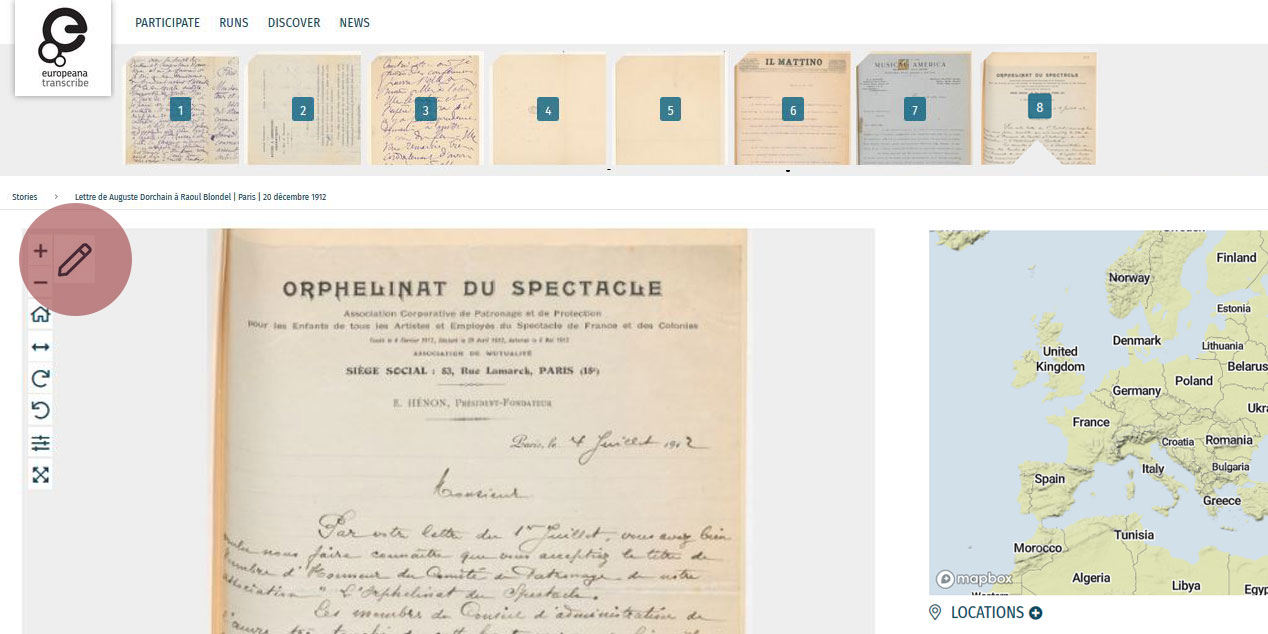
You can have the white Activity Panel docked to the right (default) , to the bottom , or as an independent overlay . If you just want to view the image, you can hide the panel using the minimise button , and then re-open it with the pen button. Adjust the size and position of your Activity Panel according to your preferences.
You enrich documents by following a step-by-step process.
Make sure you regularly save your enrichments in each step to avoid the risk of losing your work.
Step 1: Transcription
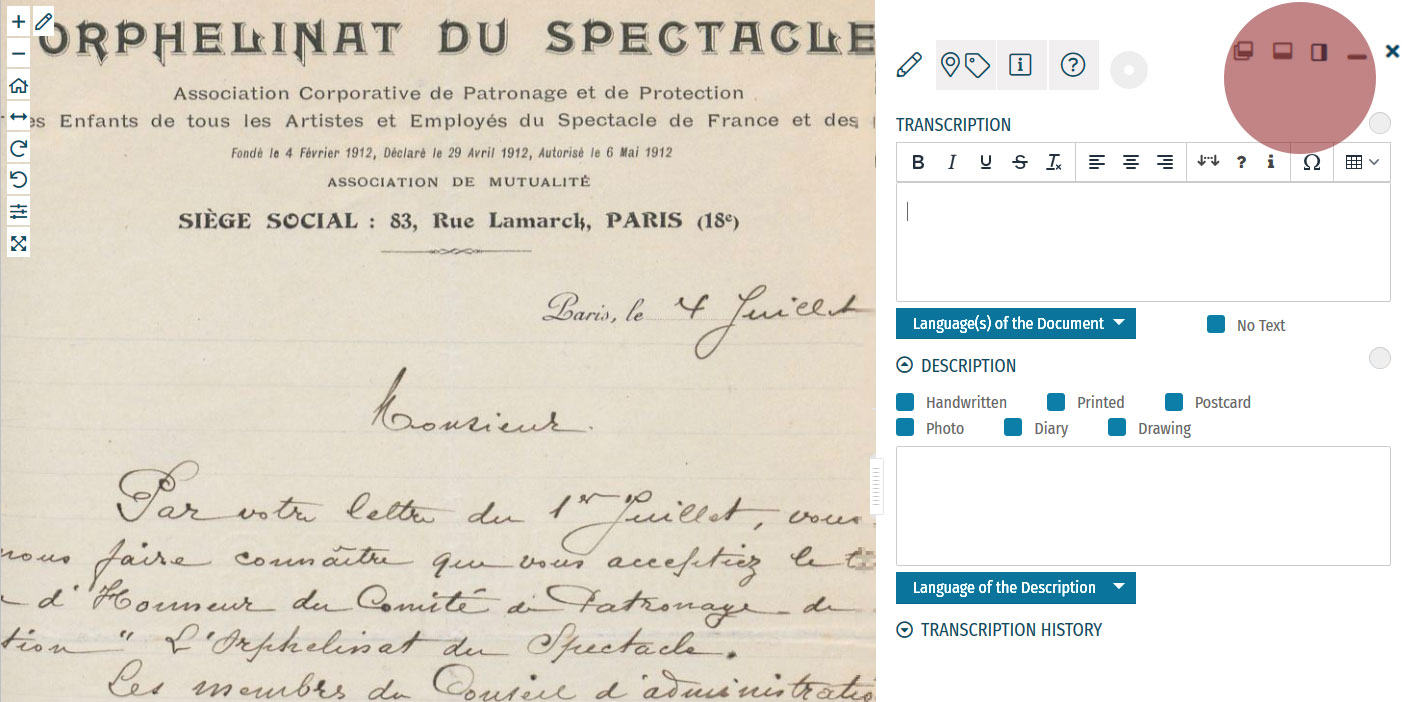
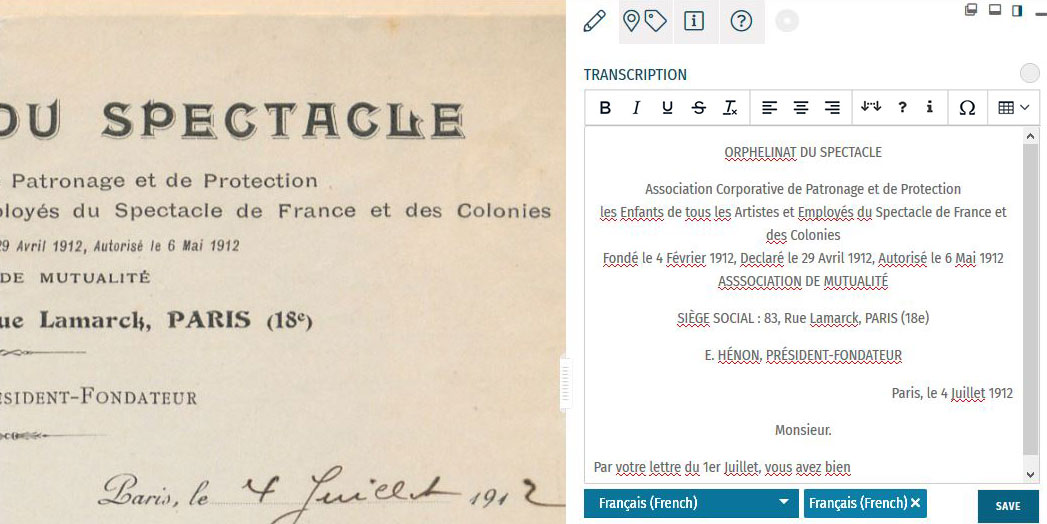
To start a transcription, select the transcription tab at the top menu of the Activity Panel. Click inside the box underneath the heading TRANSCRIPTION and start writing your transcription. When needed, use the toolbar to format your text and to add special characters and tables. A guide to the transcription toolbar is available in the Formatting section of this tutorial.
Identify the language(s) of the text using the dropdown list under the transcription box. You can select multiple languages at once.
If the item has no text to transcribe, tick the checkbox ‘No Text’.
Once you have finished your transcription, click SAVE.
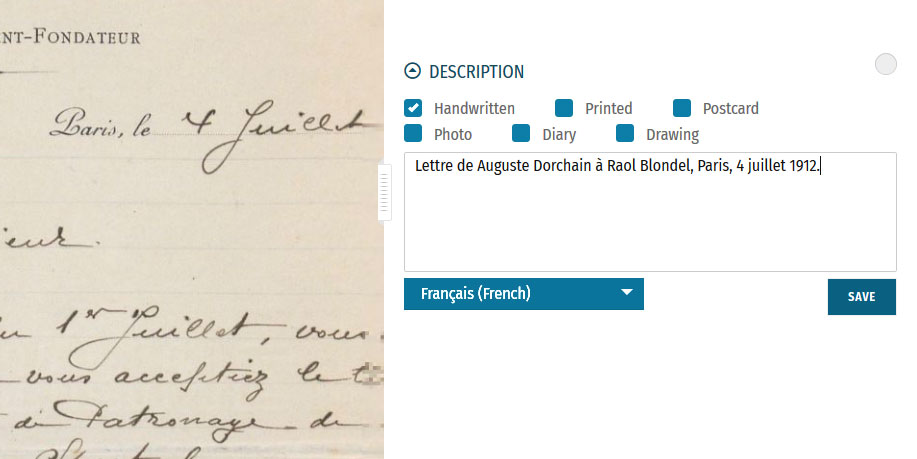
Step 2: Description
You can add a description to the item underneath the Transcription section.
The first task is to identify what type of document the item is: a handwritten or printed document, a postcard, photo, drawing and/or part of a diary. Tick the category which best applies to the item. Multiple categories can be selected at once.
The second task is to write a description of the contents. Click inside the box underneath the heading DESCRIPTION. Here, you can write what the item is, what it is about, and specify the images and objects that appear in the item.
Identify the language of the description text that you wrote using the dropdown list underneath. You can only select one language.
Once you have finished your description, click SAVE.
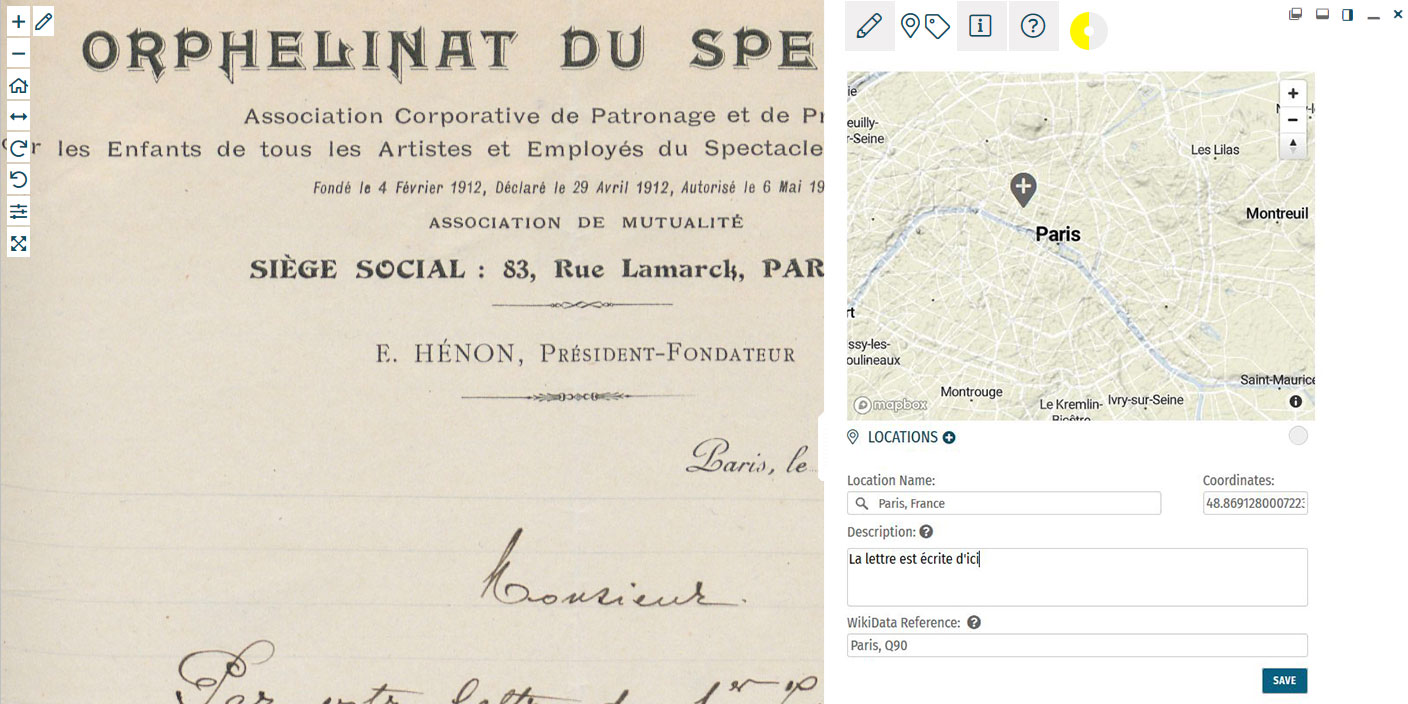
Step 3: Location
If you find a location mentioned or recognise a place in the item, you can create a geotag and pin it to the item map. Multiple locations can be attached to the item. To tag locations, select the tagging tab at the top menu of the Activity Panel. Click the plus next to the heading LOCATIONS. Type the location into the search bar and select the result that best applies. A new pin will be placed into the map. The location name should be a clear georeference, e.g. a country, city or address. Make adjustments to the location name if necessary. You can also adjust the position of the pin by dragging it on the map. If you want to add further details to the location, you can write a (short) description. This could include extra information about the geotag (e.g. the building name or a significant event that took place at the location) or the relevance of the place to the item (e.g. the hometown of the author). You can also add a Wikidata reference to link the location to a stable source. Search for the reference using the Wikidata fields. Once you have finished your location tag, click SAVE. You can find the place(s) tagged to the item in grey at the bottom of the Location(s) section.Step 4: Tagging
Below the Locations section is the Tagging section, where you can add the following annotations:
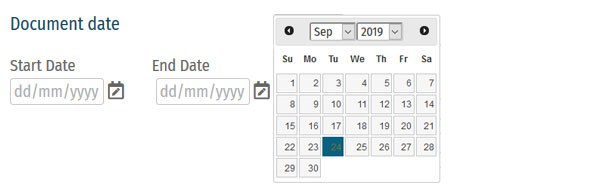 Document Date:
Here, you can add dates that correspond to the item. This could include the dates mentioned in the text (e.g. in diary pages), the date of a related historical event (e.g. the end of WWI), or when the item was created (e.g. from a dated signature on an illustration). You can either define this as a single date or as a longer time frame.
To tag dates to the item, write the start and end dates in DD/MM/YYYY format in the fields or select the dates by clicking on the calendar.
If you only have one date to add, insert the same date into both start and end fields.
If you don’t know the exact days, you can also tag the date on the scale of months (MM/YYYY) or years (YYYY).
Once you have finished your date tag, click SAVE DATE.
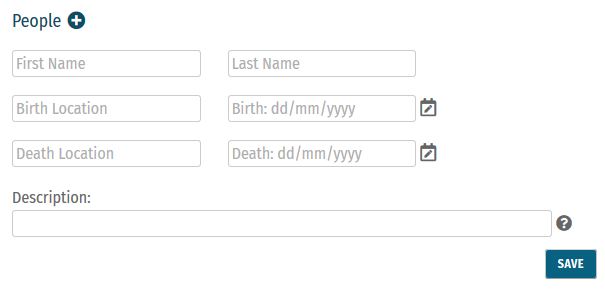 People:
People mentioned as creators or subjects in the item can also be tagged. Depending on the information you might have, you can enter the person’s first and last names, as well as their dates of birth and death. There is also the option to write a short description of the person, explaining who they are or their relevance to the item, e.g. the person’s occupation or their relation to another tagged person.
Multiple people can be tagged to one item.
Once you have finished your person tag, click SAVE.
 Keywords:
Here, you can freely add keywords related to the topic and content of the item. This could include particular themes (e.g. art, music, war), subjects (e.g. children, cooking, France), or particular historical affiliations (e.g. 20th century, Austro-Hungarian Empire, Fall of the Iron Curtain).
Multiple keywords can be added and they can be written in any language.
Write your keyword tag into the field and click SAVE.
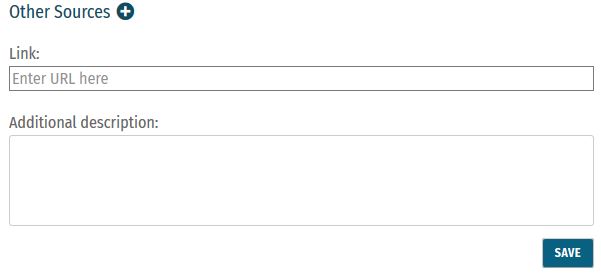 Other Sources:
External websites with information about the item’s content can be linked here. This could include links to further data about a person mentioned, a particular historical event or links to digital versions of newspapers that appear in photos or clippings in a notebook.
To add a link, click the plus next to the heading ‘Other Sources’. Enter the URL into the Link field, and write a short description of this link in the Additional Description field.
Multiple links can be tagged to one item.
Once you have finished your tag, click SAVE.
Step 5: Mark for Review
Once you have saved your contribution, the task will automatically change to the Edit status. If you think the task is finished, you can mark it for review. Note that you have to be at Runner level or above to do this (see: Miles and Levels). Click on the yellow circle next to the section heading and select Review in the list that appears. The task now needs to go under Review by another volunteer.Formatting
 Use the toolbar to format your Transcription text or to add extra details to it.
You can format your text using the various styles and alignment tools:
Use bold for headings, and italics, underline and
Use the toolbar to format your Transcription text or to add extra details to it.
You can format your text using the various styles and alignment tools:
Use bold for headings, and italics, underline and  button to remove any formatting changes.
Review
 All enrichments need to be edited and reviewed by more than one volunteer to ensure that they are as accurate as possible.
Only Sprinters and Champions can edit tasks in the Review stage and mark them as Complete. (see: Miles and Levels)
You can review a task (Transcription, Description, Locations, or Tagging) when the circle next to the heading is coloured orange .
During the review process, pay close attention to the following requirements:
All enrichments need to be edited and reviewed by more than one volunteer to ensure that they are as accurate as possible.
Only Sprinters and Champions can edit tasks in the Review stage and mark them as Complete. (see: Miles and Levels)
You can review a task (Transcription, Description, Locations, or Tagging) when the circle next to the heading is coloured orange .
During the review process, pay close attention to the following requirements:
-
- Transcription: The complete text in the item has been properly transcribed and the transcription is formatted as accurately as possible. The correct language(s) are selected and the transcription contains no missing or unclear icons.
-
- Description: The description is accurate and detailed (especially items without text to transcribe, e.g. photos), and the appropriate categories have been ticked.
-
- Location(s): All locations have been correctly tagged. The location name is accurate and matches the coordinates and the pin on the map. The description is clear and concise, and the Wikidata reference (if any) is correct.
-
- Tagging: Document dates are completed and as precise as possible. All mentioned people are tagged and their data is correct. All added keywords are applicable to the item, and other sources have accurate information and functioning links.
Completion Statuses
| GREY |
| 1. NOT STARTED |
| Tasks have not been started. |
| YELLOW |
| 2. EDIT MODE |
| Tasks have been started, but not yet finished. Additions and edits can still be made. |
| ORANGE |
| 3. REVIEW |
| Tasks are finished, but need final review by Sprinter or Champion transcribers. |
| GREEN |
| 4. COMPLETED |
| Tasks have been fully completed and reviewed. No further changes need to be made. |
Miles and Levels
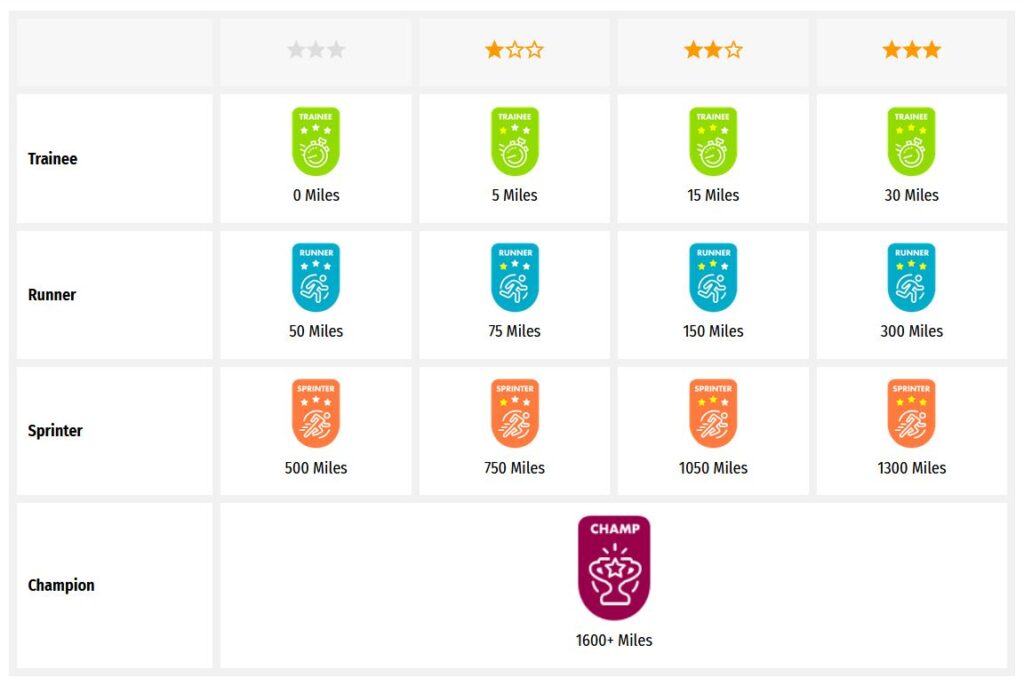
Transcribathon is a competitive marathon. You do not enrich documents alone, but compete and work with other volunteers to ensure the quality of your work. When you first create a Transcribathon account, you only have the ability to start and edit tasks. The more you enrich documents, the closer you become to advancing to a higher level, which can unlock abilities like reviewing and completing tasks.| Level | Abilities |
|---|---|
| Trainee | Basic abilities: start and edit tasks |
| Runner | Basic abilities, mark finished tasks for review |
| Sprinter | All Runner abilities, mark reviewed annotations as completed |
| Champion | All Sprinter abilities, mark reviewed transcriptions as completed |
| Tasks | Miles Received |
|---|---|
| Transcription | 1 Mile for every 300 characters transcribed |
| Description | 1 Mile for every 5 Descriptions added |
| Location | 1 Mile for every 5 Locations added |
| Tagging | 1 Mile for every 5 Tags added |
| Reviewing | 1 Mile for every 10 items marked as complete |