Letters from the front
Stories from the front lines from Joseph Oliver Reilly,to his Brother Jack editor of the Western People, Ballina, Co Mayo,during the 1914-1918 War,sent by son Jocelyn Reilly
Stories from the Gallipoli Front, from Egypt and from Malta as told by Joseph Reilly. First published in Western People.
Memoir
CREATOR
jocelyn reilly
DATE
1914 - 1918
LANGUAGE
eng
ITEMS
12
INSTITUTION
Europeana 1914-1918
PROGRESS
METADATA
Discover Similar Stories

Irish letters from the front: the McGrane brothers in the First World War
11 Items
Peter and Christopher McGrane were two Dublin brothers who served in the First World War. They were Roman Catholics who grew up in Knocklyon Castle, Templeogue Co Dublin, Ireland. Both enlisted in September 1915. Neither were married and Peter had worked as a bank official prior to enlistment. Peter (known as Leo) was a 2nd Lieutenant in the Royal Irish Regiment attached to the 3rd battalion Royal Inniskilling Fusiliers. He received officer training in London and was sent to France in November 1916. His letters home from France describe playing sport behind the lines and how used he has become to the sound of the guns at nighttime. He describes the fun of the Brigades sports day during their period of rest and the 'extremely good music', remarking wryly that 'most people here thought on yesterday afternoon that this was a very fine war'. The awareness of danger was however ever present and he mentions how glad he is that there is a Catholic chaplain with them to provide services before going into danger. In April 1917 he was hospitalized for scabies and was due to be sent home but the hospital ships were cancelled and he remained in France. A month later Peter was dead. He was killed at the Battle of the Arras on the 19th May 1917 on the Western Front. He was aged twenty-eight. His final letter, collected here, was dated 13th May 1917, less than a week before his death, making it particularly poignant, especially his closing promise to write again at the first opportunity. Peter is commemorated on the Arras memorial in France. His brother Christopher served with the Royal Flying Corps during the war. He enlisted at the age of twenty-one. He was based in France during the war, and his letter in this collection is written to his brother Jim who was back in Ireland. His letter suggests he missed home, evident by his desire for ‘all the local news’. Peter and Christopher were located less than 40 miles apart in France in May 1917 and had made plans to meet just before Peter's death. After the war Christopher left Ireland and moved to Rhodesia where he joined the police force. He did not return to Ireland except for a brief visit in 1939. The war story of Peter and Christopher was passed down through the family and his relatives found Peter's photograph a few years ago, making the story more real to them. They were recently invited to a ceremony at the Arras memorial in France. || 1 photograph of Peter McGrane in his army uniform circa 1916. 2 letters from Peter to Dublin from France dated 6 April 1917 and 13 May 1917 1 photograph of Christopher at home in Dublin circa June 1917 Letter from Christopher to his brother Jim in Dublin, July 1917 || || Photograph || This is a photograph of Peter Leo McGrane, in his British Army uniform. It was most likely taken in 1916 before he departed for France in November 1916. Peter was killed during the Battle of Arras on 19 May 1917. As such this photograph is very important to his family and serves as a poignant reminder of the young lives lost in the war. || Peter Leo McGrane || Front || Photograph of Peter Leo McGrane || Remembrance || United Kingdom || || Home Front || Dublin, Ireland || This is a photograph of Christopher McGrane in his army uniform, at home in Dublin in June 1917. Christopher served with the Royal Flying Corps during the war. This photograph was taken on leave home, about a month after the death of his brother Peter in the war. Christopher's relatives note his courage in wearing a British Army uniform in Dublin in 1917, considering the increased hostility in Ireland towards the British Army in the aftermath of the Easter Rising of April 1916. || Photograph || Front || Christopher McGrane || Photograph of Christopher McGrane || || Peter Leo McGrane || Letter from Peter Leo McGrane to Jim McGrane, 13 May 1917 || Letter || This is a letter written by 2nd Lieutenant Peter Leo McGrane, Royal Irish Regiment, attached to the 3rd Battalion Royal Inniskilling Fusiliers. He sent it from France to his brother Jim at home in Dublin on 13 May 1917. Peter's letter describes playing sport behind the lines and how used he has become to the sound of the guns at nighttime. He describes the fun of the Brigades sports day during their period of rest and the 'extremely good music', remarking wryly that 'most people here thought on yesterday afternoon that this was a very fine war'. The awareness of danger was however ever present and he mentions how glad he is that there is a Catholic chaplain with them to provide services before going into danger. He mentions receiving a letter from his brother Christy, (Christopher) who was serving with the Royal Flying Corps, and how he hoped to meet Christy in France as they were less than 40 miles apart. His letter ends with his love to his family and his promise to write again at the first opportunity. This was Peter's last letter however as he was killed on 19 May 1917 during the Battle of Arras. As such this letter is highly valued by his relatives, giving as it does some insight into the life lost in the war. || || Letter from Peter Leo McGrane to Jim McGrane, 13 May 1917 || Letter || Peter Leo McGrane || || Letter from Peter Leo McGrane to Jim McGrane, 13 May 1917 || Letter || Peter Leo McGrane || || Medical || Letter || Letter from Peter Leo McGrane, 6 April 1917 || This is a letter written by 2nd Lieutenant Peter Leo McGrane, Royal Irish Regiment, attached to the 3rd Battalion Royal Inniskilling Fusiliers. He sent it from France to his brother Jim at home in Dublin. The letter was sent on 6 April 1917. He mentions the fact that he has been ill and that he had expected to be sent home but no hospital ships was sailing so he had to stay in France to recover. He inquires about news from home and asks after his brother Christopher who was serving with the Royal Flying Corps. He also notes that it had been snowing all the previous day and hopes the weather is better at home. || Trench Life || || Medical || Peter Leo McGrane || Letter || Letter from Peter Leo McGrane, 6 April 1917 || Trench Life || || These are the envelopes which contained letters from Peter Leo McGrane and Christopher McGrane which were sent to Dublin from France in 1917. They were addressed to their brother James McGrane at Knocklyon Castle, Templeogue, Dublin, Ireland. || James McGrane || Envelopes sent from France to Dublin, 1917 || Other || || Aerial Warfare || Letter || Letter from Christopher McGrane to Jim McGrane, 18 July 1917 || This is a letter written by Christopher McGrane in France and sent to his brother Jim back home in Ireland in July 1917. Christopher serving with the Royal Flying Corps during the war. He appears frustrated at the difficulties of receiving and sending post from France and the delays he has experienced recently. He mentions however how much he enjoyed reading two books that his brother mentioned in a letter to him. He states that there is not much happenings where he is at the moment due to bad weather which he doesn't mind. Most of the other pilots are practising on the new machines which are 'good and mighty of engine'. He states that there is not much to tell that he is 'at liberty to say' but seems to prefer discussing news from home regarding the family farm. He observes that Jim must be 'living the peaceful life' and asks for all the local news from home. || Christopher McGrane || || Letter from Christopher McGrane to Jim McGrane, 18 July 1917 || Christopher McGrane || Aerial Warfare || Letter || || Letter || Christopher McGrane || Aerial Warfare || Letter from Christopher McGrane to Jim McGrane, 18 July 1917

Letters from the Front from a Father to a Daughter – James Christopher Daly
1 Item
Attestation Paper James Christopher Daly; Correspondence to his daughter; Letter September 1915 to his daughter; Letter and SAE from Soldier's Christian Association Canada; Letter from James Daly to Daughter on BEF paper; Letter to Christopher Day; Letter to his sister; Page 2 of letter to sister; Notice of Death of J. Daly 1917; Poem; SAE to Miss J. Daly || James Daly enlisted at age 36 in May 1915 in the Canadian Infantry, Western Ontario Regiment, 47th Battalion, Service No. 116370. He was from Ireland, but perhaps emmigrated to Canada to prospect/mine. In 1915 he was still in headquarters in Canada, and training. In 1916 he is in Shorncliff, England. He served in the Western Front from about 1916. He suffered some injuries during his time, but continued his service. He served in the Battle of Vimy Ridge and was wounded after this. His letters describe his injuries and the deaths of other colleagues during the battles – quite descriptive. A letter sent on 22 October 1917 to his daughter explains that he had died. It was sent by Theodore G. Thomas, Lieut., No. 7 Platoon, B. Company, 47th Batt. The official letter was sent on 30th October which confirmed the death. James Daly’s letters mention Ireland in 1916 and state that no leave was given to soldiers.
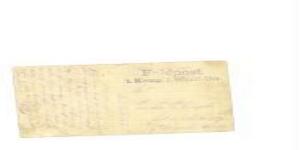
Letter from the Front
2 Items
My Grand-Mother, Maria Fischer, came from Germany, Frankenstein (now Ząbkowice Śląskie, Poland). She married a Russian prisoner-of-war (1st World War) in 1920 and then they came to the Soviet Russia. I found this post-card among their documents: 1 Komp. I. Werft-Div, man-of-war's men's photo and text on the back side. I guess this post card is from her fiancé, Ernst, who died in this War. And he is on the Photo. After the War, Russian prisoners-of-war was staying (living) in Zadel, near Frankenstein. One of them was my Grand-Father. || Post card. On the one side - there is a Photo: 1 Komp. I. Werft-Div, man-of-war's men. On the other side - letter from the front || || Remembrance || Letter || Grand-Mother, Maria Fischer || text on the back side of the post card || Back || || 1. Komp. I. Werft-Div man-of-war's men Photo || Postcard || Grand-Mother, Maria Fischer