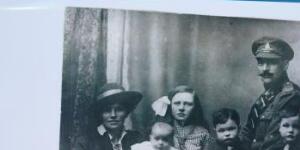
Henry Shannon (Schonman) who served with the Army Service Crops and 63rd Royal Naval Division
Transcript of interview with John Shannon
CREATOR
John Shannon
DATE
1916 - 1919
LANGUAGE
eng
ITEMS
7
INSTITUTION
Europeana 1914-1918
PROGRESS
METADATA
Discover Similar Stories

Trevor Richards | Royal Naval Division | killed on the Somme
1 Item
A photograph of Philip Richards, approximately 5 years old, returned with the possessions of Trevor Richards (Bristol Z/171, Howe Battalion, RND) killed at the Battle of the Ancre, 13 November 1916. || The attached photograph is one of two possessions returned from AB Trevor Richards, b. 22/11/1895 from Penyrheol, Gorseinon, Wales, who was killed on the Somme on 13 November 1916 (Bristol Z/171, Howe Battalion, RND). It is a photograph of his younger brother, my grandfather Philip Richards, who would have been around 5 years old at the time. He is dressed in a sailor suit due to his older brother, Trevor, serving in the Royal Naval Division.
My father William Powderly Royal Army Service Corps
8 Items
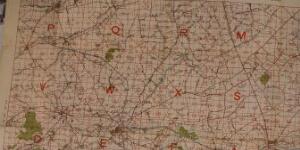
Map of a section of the Western Front in Bethune, France || || This image contains a studio style photograph of my father, also called William Powderly, who served as a driver during the full extent of the Great War from 1915 to 1918, and a photograph of him and a colleague pictured with the ambulance they drove. This image also shows my father's cap badge, which I still have and which he wore at all of the engagements in which he served including the Somme and Ypres. The cap badge in particular is very important to me as this actual item was present at many of the great battles of the war. || Picture of William Powderly with ambulance and also his cap badge || Medical || Transport || William Powderly || Photograph || || Islandbridge, Dublin || Photograph of veterans marching to a commemoration at Islandbridge || William Powderly, Remembrance ceremony at Islandbridge || Remembrance || This is a picture of World War 1 veterans, including my father William Powderly, marching to a Remembrance commemoration at Islandbridge in Dublin at a date sometime between the 1930s and the 1950s. I accompanied my father on many of these occasions and I played The Last Post on a bugle at many Remembrance ceremonies during this period. There was a great sense of fellowship among the comrades from the Great War but after Irish independence these veterans of the War were not popular in Ireland and the Remembrance ceremonies were not supported by either the public or the Irish government until recent years. || || Official document || My father's driving licence for the Royal Army Service Corps || Driving licence of my father, William Powderly, who served in the Royal Army Service Corps as a driver on the Western Front between 1915 and 1918. || William Powderly || || Leave sheet of William Powderly || Leave sheet of my father, William Powderly, granting him leave in 1917 from Rouen in France to spend time at home in Dublin, Ireland. || || Recruitment and Conscription || William Powderly's certificate on entering active service in 1915 || || Medal card for the service medal of my father, William Powderly, who served in the Royal Army Service Corps on the Western Front during the Great War. || Medal card of William Powderly - M21 073990 || || Remembrance || Group of veterans at Remembrance ceremony at Islandbridge in Dublin || Photograph of a group of veterans, including my father William Powderly, attending a Remembrance ceremony at Islandbridge in Dublin. I have fond memories of attending such events with my father over many years.
Henry Harry Lucas | The Royal Garrison Artillery and Flanders
1 Item
Photograph showing Henry Lucas in uniform ; Replica Medals British Service Medal, and the Victory Medal ; Photograph of us at our Grandfathers Grave at the military cemetry at Esquelbecq. || Our Grandfather Henry Harry Lucas was born in Nenagh in Co. Tipperary. We know he moved to Dublin where he lived for a while in Merrion Avenue where he was employed as a coachman. We are not sure the reasons our Grandfather enlisted but he did and was to serve with The Royal Garrison Artillery. We do know thanks to war records that the 39th siege Battery had served in the Somme area up until 1915, it is unknown to us whether our Grandfather had served there although we do know that he had served in Flanders between 1915 and 1918. It was in 1918 when our Grandfathers service had ended after sustaining wounds after what we believe to be during the second German offensive of 1918 where all the lines seemed to have been overrun. Henry we also know had been moved to an Australian casualty clearing station in Esquelbecq where he died of septisemia two weeks later. Our Grandfather is buried at the cemeterary in Esquelbecq that had been opened in 1918. We unfortunately have no original medals although his medal certificate we obtained from the national archives allowed us to purchase replicas (picture above). Our Grandfather's uncle was also a soldier who was one of the first recipients of the Victoria Cross. John Lucas V.C had been awarded this medal for his outstandig galantry during the New Zealand Wars. In recognition of our Grandfather's sacrife he and other parishoners are remembered on a plaque in the Holy Trinity Church in Rathmines.