Map of Zitni Potok | the place where the described events during the Toplica insurrection took place
Map of Zitni Potok, the place where the described events during the Toplica insurrection took place. The map is taken from the book Pusta Reka i Pustorečani by Milutin Đorđević
Back
CREATOR
Ljubiša Milošević
DATE
2001
LANGUAGE
srp
ITEMS
1
INSTITUTION
Europeana 1914-1918
PROGRESS
METADATA
Discover Similar Stories

Postcard: Aire-sur-la-Lys - View of the Grand Place
1 Item
Front || Postcard: Aire-sur-la-Lys - View of the Grand Place one day in March. Caption: Vue de la Grand Place un jour de marche.

Serbia's Toplica Insurrection commemorative badge
2 Items
Badge commemorating the 1934 memorial to the fallen of the Toplica Insurrection, the only popular uprising during the First World War to take place in an occupied country. || After the Serbian tactical retreat in the winter of 1915, the Serbian Army left behind guerilla units to fight and harass the enemy occupation forces, and these units were known as Chetniks, from the South Slavic word 'cheta', which is an armed band or troop, but they were also known as 'comitadji'. The Serbian Army Command send Chetnik 'Vojvoda', ie. rank of leader, Kosta Pecanac, by air to the region in late 1916 to help organise resistance to the Bulgarian occupation forces. In early 1917, the local population of a couple of towns near the river Toplica had heard rumours that the Allies had reached Skoplje, the provincial capital of Serbia's southern province of Macedonia, and, already wary of cases of the Bulgarian Army being abusive towards local women and drafting local men into the occupying, Bulgarian Army, with perhaps the hope of linking through to Skoplje, Pecanac and his men organised a force of several hundred local insurgents from the Toplica region towns of Prokuplje and Kursumlija. In the more than month of fighting that followed, with anyone who the Bulgarian Army even suspected of helping the rebellion being executed on the spot, the homes burned down, and their property stolen, estimates of the dead, including many civilians, range from several thousand to perhaps 6 or 7 times that amount. This badge is to commemorate the 1934 memorial to the fallen of the Toplica uprising, which was the only popular uprising within an occupied country during the First World War. The design on the badge shows a pair of attacking figures with, beneath them, the text in Serbian Cyrillic 'СПОМЕН 1934 ПАЛИМ ТОПЛИЧАНИМА', which transliterates to 'Spomen 1934 the fallen Toplicanima', and translates as 'Memorial 1934, to the fallen of Toplica'. The design is taken from the memorial in the town of Prokuplje, and the memorial designers name is on the badge, in Serbian Cyrillic, 'Ф.М. ДИНЧИЋ', transliterates to 'F.M. Dincic', who was the artist and sculptor Frano Meneghello Dincic, who also designed and produced busts, medals, money, and also other First World War memorials in the Serbian towns of Jagodina, Sabac, and Zajecar.
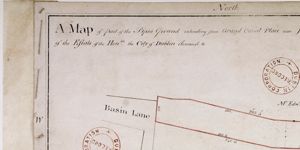
Map of part of the Pipes Ground extending from Grand Canal Place near James' Street to Basin Lane .. City Estate.
1 Item
Holding bounded by Basin Lane on west; by holding of Edward Stephens on north; by Grand Canal Place on east; and by Tyrell's Tan Yard on south - see also C1/S1/67