Samuel Bodger | gunner RGA
A letter from Portland in 1915 about a cake.
A letter from the trenches with a flower and butterfly enclosed.
Three embroidered or embellished souvenir cards
Photograph of Samuel Bodger's father, also Samuel Edmund Bodger, on horseback.
Samuel Edmund Bodger, gunner RGA, trained at Portland when he enlisted for the War.
His wartime correspondence with his family contains remarkable items from the landscape of the trenches. In his letter written from the trenches the day before the Spring Offensive, March 20th, 1918, he encloses a dried leaf (violet) and a butterfly. These were subsequently kept in the family bible.
The letter complains about a girl's failure to write to him and mentions picking flowers in the trenches.
Samuel's embroidered souvenirs were kept by the contributor's (his niece) parents, on the mantelpiece in their bedroom.
Samuel's father, also called Samuel Edmund Bodger, enlisted when in his 40s, but survived the war into the 1960s. He was a member of the Devonshire Yeomanry.
Samuel Bodger's correspondence
Butterfly and Violet enclosed in a letter from the Western Front before the Spring Offensive
Butterfly and Violet enclosed in a letter from the Western Front
Letter
Western Front
Embroidered Card
Samuel Bodger's Embroidered Card
Postcard
Photograph
Samuel Bodger's father, Devonshire Yeomanry
CREATOR
Hazel Mills
DATE
1914 - 1918
LANGUAGE
eng
ITEMS
18
INSTITUTION
Europeana 1914-1918
PROGRESS
METADATA
Discover Similar Stories

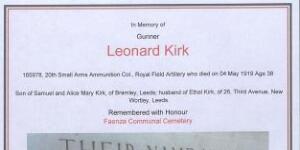
Gunner Leonard Kirk
1 Item
Photograph of Leonard Kirk in uniform || My grandfather Leonard Kirk was born in Leeds as one of nine sons, of whom two died in Flanders. Leonard himself died from pneumonia on his way home to his family in May 1919. His brother Joe did make it home but was badly wounded and shell shocked and never worked again. When the First World War broke out, Leonard was visiting England from Chicago with his wife Ethel (they had emigrated in 1910) awaiting the birth of their second child, my father George. Leonard wanted to do his bit and joined up. He went through the war uninjured, but then died on 4th May 1919 at the age of 38. He died in Italy and is buried at Faenza. Leonard was a gunner with 20th Small Arms Ammunition Column Royal Field Artillery. Because Leonard did not die in action or from wounds, Ethel was not classed as a war widow and therefore received a widow's pension of £2.4s.9d. Leonard was the son of Samuel and Alice Mary Kirk of Bramley, Leeds.

The Lewis Gunner
125 Items
Certificate of service; pay book; note book; regimental Christmas card 1918; Documents including letters and photographs; medals; cap and uniform badges; coin used for target practice; crucifix and devotional book; hip flask, regimental baton, pages from note book (plus pdf of all images). || My father, William Francis Charles Stone, was born in 1898 in Headington. He was the eldest son and his father was a builder and his mother ran the general store in Pitts Road, Headington Quarry. William trained as a woodcutting machinist and worked for Mrs Oborne of Oxford High Street before the war. Mrs Oborne gave him a prayer book (the Treasury of Devotion)and a crucifix for him to wear. His mother and his employer were surprised when he volunteered in April 1915 aged only sixteen, joining the Oxford and Buckinghamshire Light Infantry as a private. His father also served in the war, in the Royal Army Service Corps. William was gassed twice, fought at the Somme and in 1917 he was transferred to the 2nd Battalion (commonly referred to as the 52nd). William was a very good shot - he used to put a coin on the railing of the footpath down Headington Hill and shoot at it for target practice. He was a Lewis Gunner and achieved a first class classification in 'musketry'. He did not really talk much about the war although he did mention the mud in the trenches. After the war he had nightmares and found it very difficult. He spoke of climbing over dead bodies at the Somme. He never wore his medals, they are still in the original envelopes and the ribbons were never attached. When the war ended, he went to Germany as part of the occupying force after the Armistice. He returned to Britain in 1919 and he then stayed in the reserves for a number of years. He was in the Home Guard during the Second World War. His mementoes of the war included a collection of postcards from his various postings and a spirit flask, which he used to take to Oxford United football matches after the war. || || William Stone || A collection of photographs showing my father during his war service as well as other family photographs taken during the war, showing his father and his mother and siblings || Multiple || Photographs of my father, William Francis Charles Stone and family || || Collection || William Stone || Mementoes of William Stone || Mementoes kept by my father, William Stone, including a letter from his mother, a crucifix given to him by his former employer, Mrs Oborne, also a prayer book from Mrs Oborne. There are also his service and pay book, his note book and regimental badges. The coin is one he shot at as target practice on Headington Hill. || || William Stone || William Stone's medals || British War Medal and Victory Medal awarded to William Stone || Medal